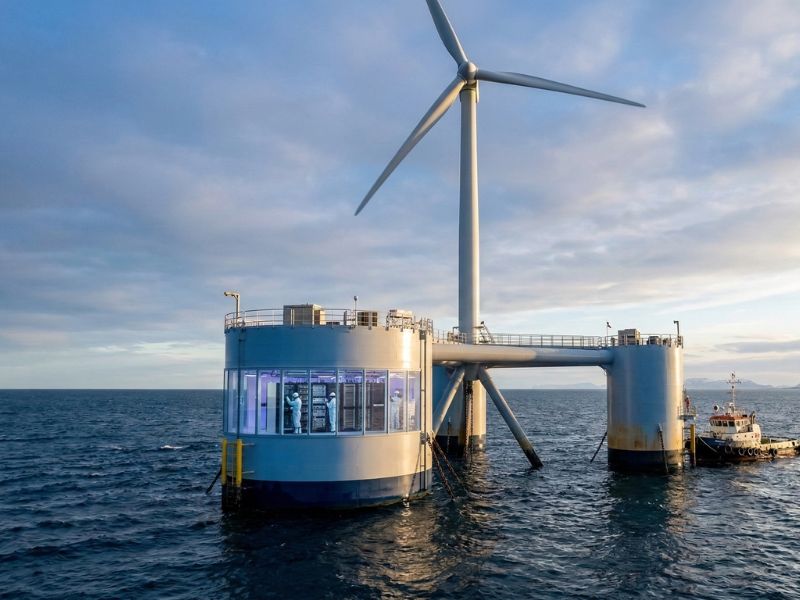
A San Francisco startup is testing an innovative offshore system that combines renewable energy with floating data centers to support the growing power demands of artificial intelligence.
San Francisco, California, 9 March 2026 —As artificial intelligence continues to expand rapidly, the demand for powerful data centers is growing at an unprecedented rate. Meeting this demand has become a challenge, especially in areas where energy supply, land availability, and community concerns limit large infrastructure projects.
A San Francisco-based startup, Aikido Technologies, is exploring an innovative solution that could transform both renewable energy and data infrastructure. The company is developing offshore wind turbines that can also host AI data centers, creating floating platforms capable of generating power and processing data at sea.
The project aims to combine clean energy production with advanced computing facilities in a single offshore structure.
A new approach to powering AI
Artificial intelligence systems require enormous amounts of electricity to run powerful computing hardware. Many large technology companies, often called hyperscalers, are struggling to find locations that can support the energy and space requirements of modern AI data centers.
At the same time, new projects frequently face local opposition due to concerns about environmental impact, land use, or infrastructure development.
Aikido Technologies believes offshore platforms could solve many of these challenges. By placing data centers directly on wind-powered platforms in the ocean, companies can generate renewable energy and run AI servers without competing for land resources.
The company plans to launch a pilot system by the end of 2026 off the coast of Norway in the North Sea. The first unit will produce around 100 kilowatts of power while supporting an AI server system on the same floating structure.
How the floating platform works
The offshore platform is built using a semi-submersible design, a technology commonly used in offshore oil and gas drilling. This structure allows the turbine to remain stable even in rough ocean conditions.
The platform stands on three large legs that are partially submerged in the water. These legs contain ballast tanks filled with fresh water, which help maintain buoyancy and stability.
To keep the structure in position, the platform is anchored to the seabed with chains and heavy anchors. This allows the wind turbine to stay within a designated area while still adapting to waves and strong winds.
The upper sections of the legs provide space where data center equipment can be installed. According to the company, each leg could eventually support a data hall capable of producing three to four megawatts of computing capacity.
If fully developed, a single offshore wind platform could host between nine and twelve megawatts of AI computing power.
Natural ocean cooling for high-performance computing
One of the biggest challenges for data centers is cooling. High-performance AI chips generate significant heat and require advanced cooling systems to maintain efficiency.
Aikido’s design uses the surrounding ocean environment to address this problem. The fresh water stored in the platform’s ballast tanks can be pumped toward the AI chips to absorb heat from the servers.
Once the water warms up, it is returned to the ballast tanks where the cold waters of the North Sea naturally cool it again. This cycle creates an efficient water-cooling system powered by the ocean itself.
For components that cannot be cooled by water, the system also includes air-conditioning units to maintain proper operating temperatures.
The future of offshore data infrastructure
If successful, floating wind-powered data centers could represent a major shift in how digital infrastructure is built and powered.
Combining renewable energy generation with data processing could reduce the environmental footprint of large-scale computing while also helping technology companies expand their AI capabilities.
The concept could also support remote data processing, edge computing services, and global cloud infrastructure without requiring new land-based facilities.
As demand for artificial intelligence computing continues to grow, innovative solutions like offshore data centers may become an important part of the global digital economy.
By bringing together offshore wind power, renewable energy innovation, and AI infrastructure, companies like Aikido Technologies are exploring new ways to meet the future’s growing demand for sustainable computing power.














Latest News